Short answer
Crested geckos are most active at dusk and dawn, so many owners never see them eat and think they are not eating when they are. Weigh yours in grams to be sure. Common causes of a real refusal are a new home, an enclosure that is too hot or too cold, a baby in an enclosure that is too big, too much fruit, or a switch of diet brand. A gecko that loses weight, a juvenile that keeps refusing food, or a gecko that also seems weak needs a reptile vet.
First: is it really not eating?
Crested geckos are most active at dusk and dawn,3 so you may rarely see them eat.
Before you change anything:
- Weigh it in grams, and again a week later. The RSPCA recommends regular weighing so you can see that a growing gecko is gaining and an adult is holding steady.3
- Look for lick marks in the diet and droppings in the enclosure.
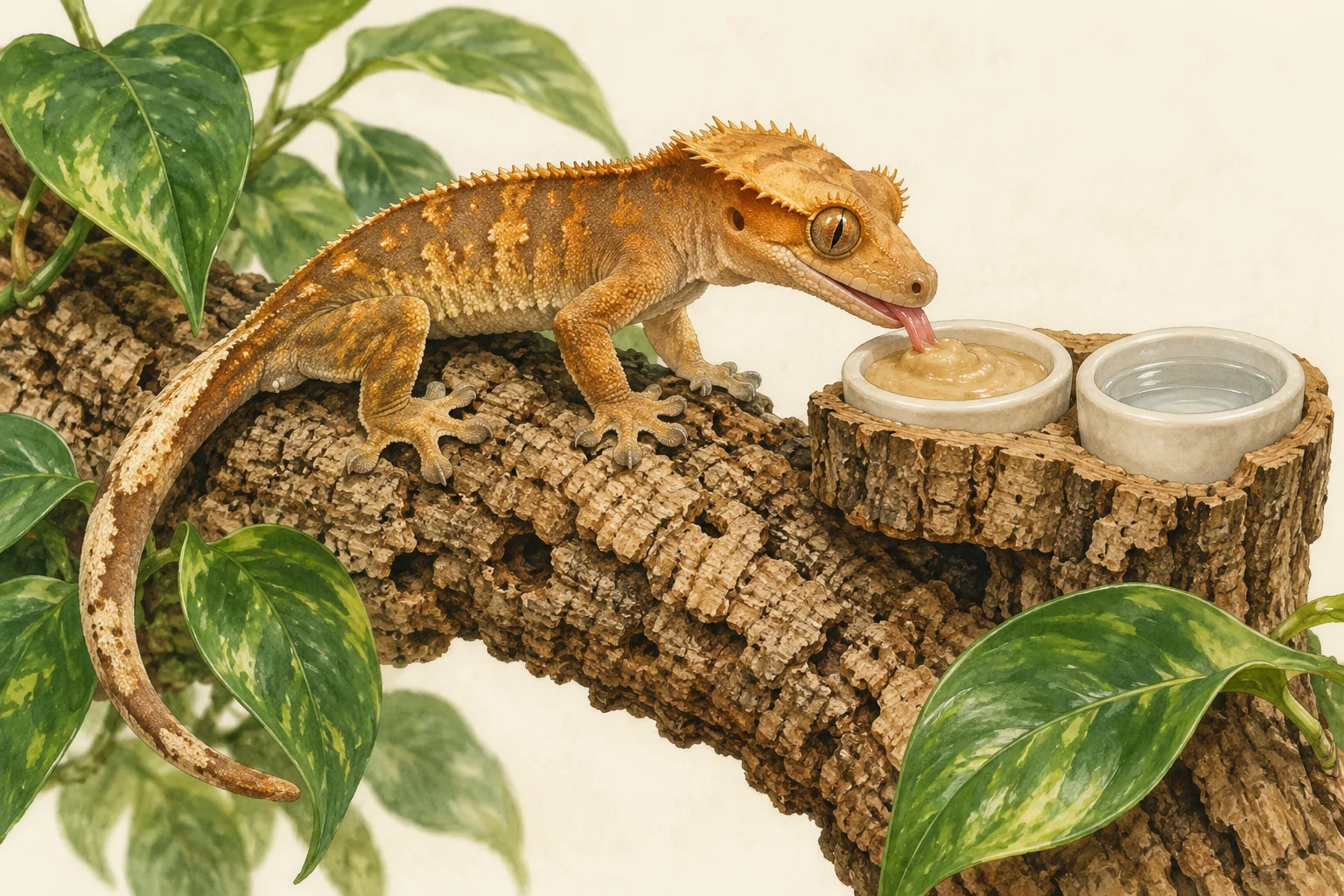
- Offer food in the evening.
If the weight is steady or rising, your gecko is eating enough.
The usual causes
A new home
New geckos often eat little for the first days. Pangea suggests a one- to two-week settling period before you start handling,1 and the RSPCA says not to handle a new gecko for its first week.3 Keep the room quiet and let it find its food and hides.
Too warm, or too cold
This one is easy to miss, because crested geckos need less heat than bearded dragons or leopard geckos. Pangea says crested geckos become stressed at 82°F or warmer.1 ReptiFiles allows a slightly warmer basking spot, but says temperatures consistently above 85°F can cause stress and heat stroke, and that temperatures consistently at or below 72°F can cause lethargy and poor appetite.5
| Source | Warm spot | Cool side | Night |
|---|---|---|---|
| RSPCA | 79–82°F (26–28°C) basking3 | 68–75°F (20–24°C)3 | Can drop to 64–68°F (18–20°C)3 |
| RVC | About 82°F (28°C) basking4 | About 77°F (25°C)4 | About 68°F (20°C) minimum4 |
| ReptiFiles | 82–85°F (28–29°C) basking5 | 70–75°F (21–24°C)5 | 65–72°F (18–22°C)5 |
| Pangea | No separate warm spot; 70–78°F overall most of the year1 | Drops into the mid-60s are tolerated1 |
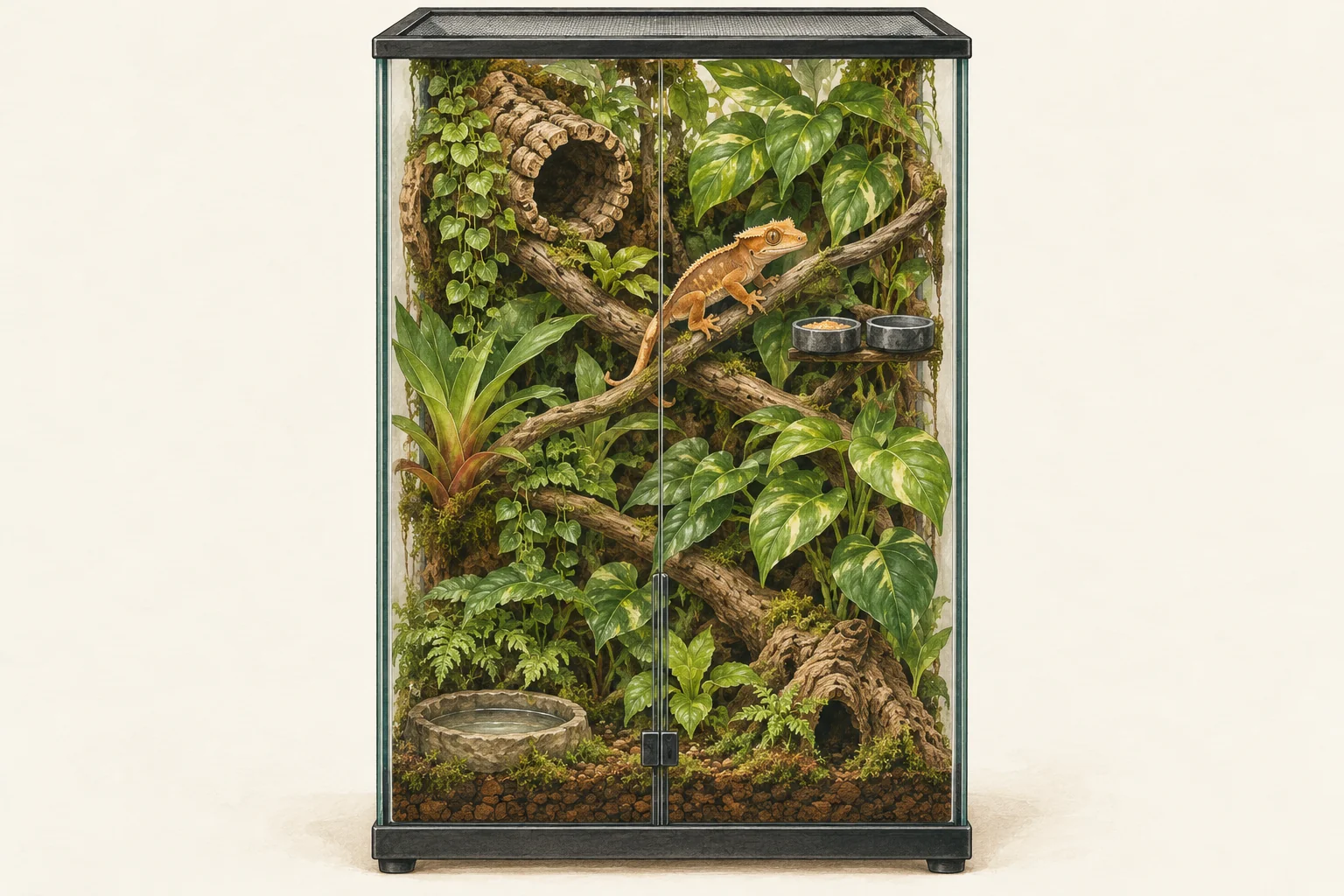
Check with a digital thermometer at gecko height, especially in summer. A room that is fine for you can be too hot at the top of a tall enclosure.
A baby in a big enclosure
Pangea says that in some cases young geckos housed in large cages will not eat well, and keeps hatchlings up to 12 weeks in an enclosure no larger than 8 × 8 × 12 inches.1 A baby in an adult-sized enclosure may simply not find its food. Put the food cup near where it sleeps.
Too much fruit, or a new brand
- Fruit. ReptiFiles warns that offering fruit too often can make a gecko reject its prepared diet.2 Keep fruit as an occasional treat.
- A new brand or flavor. Geckos generally prefer the food their breeder raised them on.2 Ask the breeder what they fed. ReptiFiles’ advice is to find what your gecko likes and stick to it.2
- Old food. The RSPCA says to remove mixed diet daily because it turns sour quickly.3
Breeding
Breeding females may need extra calcium.1 A female with a swollen belly that stops eating should see a vet.
How often to feed
| Age | Prepared diet | Insects |
|---|---|---|
| Juveniles, 0–12 months | Daily | 1–2 times a week |
| Adults, over 12 months | Every 2–3 days | 0–1 times a week |
Schedule from ReptiFiles.2 ReptiFiles recommends brands including Pangea, Repashy, Arcadia, Black Panther Zoological and Leapin’ Leachie, and dusting insects with calcium.2
Where the sources disagree
Diet alone or variety? Pangea says crested geckos can be kept on a powdered diet alone, but recommends insects once or twice a week for best health.1 ReptiFiles says insects are not strictly needed for survival, but that crested geckos still need bugs, even on a good diet.2 The RSPCA recommends a varied diet of fruit and insects, with the powdered diet as a supplement rather than the only food, rotated over three weeks.3 The RVC says crested geckos are typically fed a complete formulated diet. Its alternative is fruit and dark leafy greens daily, with insects once or twice a week.4 Pangea also makes one of these diets, which is worth knowing when you read its advice.
Banana. ReptiFiles lists banana as a fine occasional fruit.2 The RSPCA says never to feed banana or citrus.3 With a split like this, it is easy to choose other fruits.
Common questions
How do I know if my crested gecko is eating?
Look for small lick marks in the diet, a slightly lower level in the cup, and droppings in the enclosure. The surest check is weight: weigh in grams every week or two. A steady or rising weight means it is eating enough.
My new crested gecko has not eaten since I brought it home. Is that normal?
It is common for a new gecko to eat little at first. Pangea suggests a one- to two-week settling period before handling, and the RSPCA advises not handling for the first week. Keep offering fresh diet and check the temperatures.
How often should I feed a crested gecko?
ReptiFiles suggests prepared diet daily for juveniles and every two to three days for adults, plus insects once or twice a week for juveniles and up to once a week for adults.
Can crested geckos live on powdered diet alone?
Pangea says crested geckos can be kept on a complete powdered diet alone, but recommends insects once or twice a week for best health. ReptiFiles says that even on a good diet, crested geckos still need bugs. The RSPCA recommends a varied diet and says the powdered diet is a supplementary food that should not be used exclusively.
Is it too hot for my crested gecko?
Pangea says crested geckos become stressed at 82°F or warmer. The RSPCA gives a basking spot of 79–82°F (26–28°C) and a cool side of 68–75°F (20–24°C), so most of the enclosure should be cooler than 80°F.
How long can a crested gecko go without eating?
We have not found a veterinary source that gives a safe number of days. Juveniles have less reserve than adults. Use the scale: any weight loss, or a juvenile that keeps refusing food, is a reason to see a vet.
Sources
Numbers in the text link to these sources. We checked each one on the date shown.
- 1Crested Gecko CarePangea Reptile (diet maker and breeder). Checked Oct 29, 2026.
- 2Crested Gecko FoodReptiFiles. Checked Oct 29, 2026.
- 3Caring for your Crested GeckoRSPCA. Checked Oct 29, 2026.
- 4Crested gecko care (reviewed December 2024)RVC Exotics Service, Royal Veterinary College. Checked Oct 29, 2026.
- 5Crested Gecko Lighting, Temperature & Humidity RequirementsReptiFiles. Checked Oct 29, 2026.
Update history
- : First published.
- : Updated ReptiFiles temperatures to its current care guide, and added the too-cold cause.
- : Re-checked every claim against its sources; corrected wording, numbers and attributions.
HerpWise Editorial · About the author and review process
HerpWise Editorial summarizes published veterinary, welfare and specialist care guidance. The sources and check date are listed on each guide. Veterinary review is credited separately when completed.
Suggest a correction to this guide