Short answer
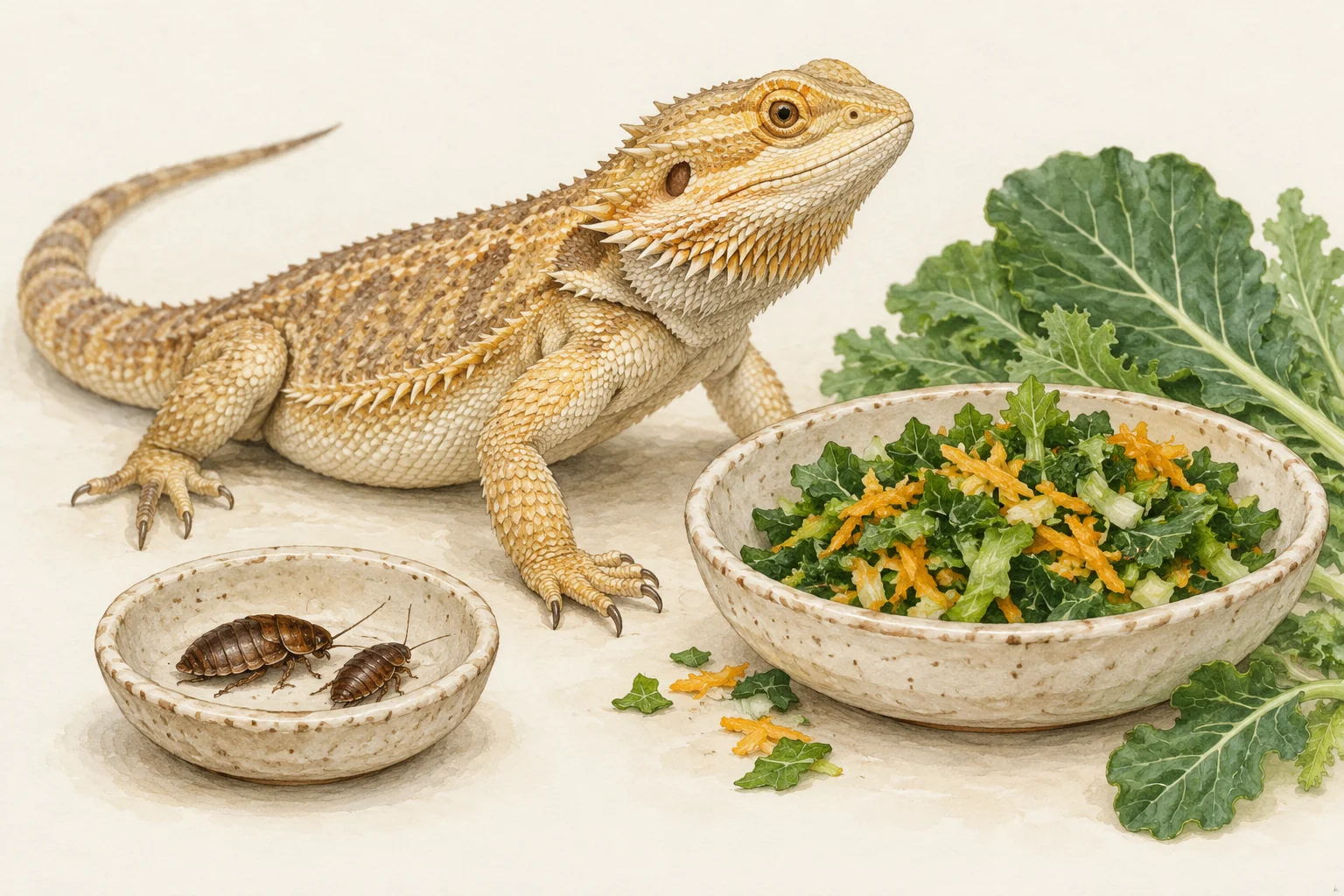
Bearded dragons eat live insects and fresh greens. Babies need mostly insects; adults need mostly greens, with insects about twice a week. Good staples are collard, mustard and turnip greens, escarole and dubia roaches or crickets dusted with calcium. Keep fruit and fatty worms as rare treats. Never feed fireflies, avocado, onion or wild-caught insects, and always leave out fresh water.
Insects or greens? It depends on age
Young bearded dragons are mainly insect eaters, and adults are mainly plant eaters.2 ReptiFiles gives these shares of protein (insects) in the diet:1
| Age | Insects | Greens and vegetables |
|---|---|---|
| Hatchlings, 0–3 months | 60–80% | the rest, offered daily |
| Juveniles, under 12 in | about 60% | the rest, offered daily |
| Adults | 15–30% | most of the diet |
This is where many owners go wrong. In a survey of owners of subadult and adult bearded dragons in the US and Canada, 55.3% of the 342 who answered the diet questions fed a diet that was more than half insects.5 That suits a baby but not an adult.
How often to feed
| Age | Insects | Salad |
|---|---|---|
| Hatchlings, 0–3 months | Once a day, as many as they will eat | Daily |
| Juveniles, under 12 in | 5–6 insects a day | Daily, about three times the volume of the insects |
| Adults, over 12 in | 3–4 insects twice a week | Three times a week, a portion the size of the dragon’s head |
Schedule from ReptiFiles.1 VCA puts it more loosely: young dragons once or twice a day, adults every 24 to 72 hours, adjusted to appetite.2
Insect size: no bigger than the space between the dragon’s eyes.1 Remove uneaten insects after about 30 minutes.3
Staple greens
Both VCA and ReptiFiles list these as good everyday greens:12
- Collard greens
- Mustard greens
- Turnip greens
- Escarole
- Bok choy
- Watercress
- Kale (see the note below)
ReptiFiles also lists arugula, endive, cactus pads, pea shoots and spring mix as staples.1 VCA adds dandelion greens, clover, cilantro, parsley, green beans and bell peppers.2
Rotate. Feed a mix of three or four greens rather than one. VCA warns that kale, cabbage and mustard greens contain goitrogens, which can affect the thyroid in large amounts.2 ReptiFiles considers kale safe to feed regularly in rotation.1 Rotation satisfies both.
Vegetables to feed now and then
Squash, bell pepper, peeled cucumber, grated carrot, asparagus, zucchini, parsley and edible flowers such as dandelion, hibiscus and rose petals are fine as part of the mix.12
Spinach, Swiss chard and beet greens: feed sparingly. They contain oxalates, which block calcium absorption.2
Insects
| Use as staples | Use as treats only |
|---|---|
| Dubia and discoid roaches, crickets, black soldier fly larvae, silkworms, captive-bred hornworms, locusts1 | Mealworms, superworms, butterworms and waxworms, which are high in fat.1 VCA lists mealworms with crickets and dubia roaches, but says to give waxworms and superworms sparingly.2 |
- Gut-load insects before feeding: VCA says within 12 hours, ReptiFiles says at least 24 hours ahead.21
- Never feed wild-caught insects. They can carry pesticides and natural toxins.12
Fruit
Fruit is a treat. VCA keeps it to 10–20% of the plant part of the diet.2 ReptiFiles is stricter and suggests about once a month, because the sugar can lead to obesity and a study it cites linked fruit to dental disease.1
Safe choices include berries, mango, papaya, melon, apple, figs and peaches.1
Foods to never feed
| Food | Why |
|---|---|
| Fireflies | Toxic. In 1999, Cornell researchers linked firefly poisoning to the deaths of bearded dragons and other lizards. A single firefly can kill a lizard.4 VCA says never to feed them.2 |
| Wild hornworms and box elder bugs | Listed as toxic by ReptiFiles.1 |
| Any wild-caught insect | Risk of pesticides and fertilizers.2 |
| Avocado | Listed as poisonous by ReptiFiles.1 |
| Onion | Listed as poisonous by ReptiFiles.1 |
| Mushrooms | Listed as poisonous by ReptiFiles.1 VCA lists them among vegetables to feed in small amounts.2 With the sources split and no need for them, leave them out. |
Supplements
| Supplement | ReptiFiles | VCA |
|---|---|---|
| Calcium | A generous dusting on insects and a light sprinkle on salads1 | Phosphorus-free calcium, lightly dusted daily2 |
| Calcium with vitamin D3 | Not specified | Two to three times a week2 |
| Multivitamin | On salads twice a week for young dragons, once a week for adults1 | Ask your vet2 |
VCA warns that getting supplements wrong, especially vitamin D3, is common.2 Pick one routine and ask your vet to check it.
Water
Keep fresh water out at all times, in a shallow bowl that is hard to tip, and change it daily.2 In the owner survey, only 64.6% of owners always provided a water bowl.5
Many dragons drink little from a bowl. VCA suggests misting or wetting vegetables before feeding, and a light mist on the dragon itself.2
Common questions
Can bearded dragons eat fruit?
Only as a treat. VCA keeps fruit to 10–20% of the plant part of the diet. ReptiFiles is stricter and suggests fruit about once a month, because of its sugar.
Can bearded dragons eat lettuce?
Neither VCA nor ReptiFiles lists iceberg lettuce as a staple. ReptiFiles does include spring mix and arugula. Base the salad on darker greens such as collard, mustard and turnip greens.
Can bearded dragons eat spinach?
Only occasionally. VCA says to feed spinach, Swiss chard and beet greens sparingly because their oxalates block calcium absorption.
Can I feed my bearded dragon bugs from the garden?
No. Both VCA and ReptiFiles advise against wild insects because of pesticides and natural toxins. Fireflies can kill a lizard, and ReptiFiles lists wild hornworms and box elder bugs as toxic.
How many insects does a bearded dragon eat?
ReptiFiles suggests 5–6 head-sized insects a day for juveniles, and 3–4 head-sized insects twice a week for adults, or an equivalent portion of smaller insects. Each insect should be no wider than the space between the dragon's eyes. Salad is daily for juveniles and three times a week for adults.
Do greens need to be dusted with calcium too?
ReptiFiles dusts insects generously with calcium and sprinkles it lightly on salads, and adds a multivitamin to salads once or twice a week. VCA recommends a light daily dusting of phosphorus-free calcium. Ask your vet to confirm the routine for your dragon.
How do I know if an insect is too big?
ReptiFiles says no bigger than the space between the dragon's eyes. It allows some leeway for superworms and hornworms, but says the rule matters most for roaches and crickets.
Sources
Numbers in the text link to these sources. We checked each one on the date shown.
- 1Bearded Dragon Diet & NutritionReptiFiles. Checked Oct 29, 2026.
- 2Bearded Dragons: FeedingGregory Rich, DVM; Laurie Hess, DVM; Rick Axelson, DVM. VCA Animal Hospitals. Checked Oct 29, 2026.
- 3Bearded dragon careRVC Exotics Service, Royal Veterinary College. Checked Oct 29, 2026.
- 4Poisonous North American fireflies are killing exotic zoo and pet lizards, Cornell biologists warnCornell Chronicle (on Knight, Glor, Smedley et al., Journal of Chemical Ecology, 1999). Checked Oct 29, 2026.
- 5Survey of Feeding Practices and Supplement Use in Pet Inland Bearded Dragons of the United States and CanadaJournal of Herpetological Medicine and Surgery, vol. 32, no. 3. Checked Oct 29, 2026.
Update history
- : First published.
- : Re-checked every claim against its sources; corrected wording, numbers and attributions.
HerpWise Editorial · About the author and review process
HerpWise Editorial summarizes published veterinary, welfare and specialist care guidance. The sources and check date are listed on each guide. Veterinary review is credited separately when completed.
Suggest a correction to this guide