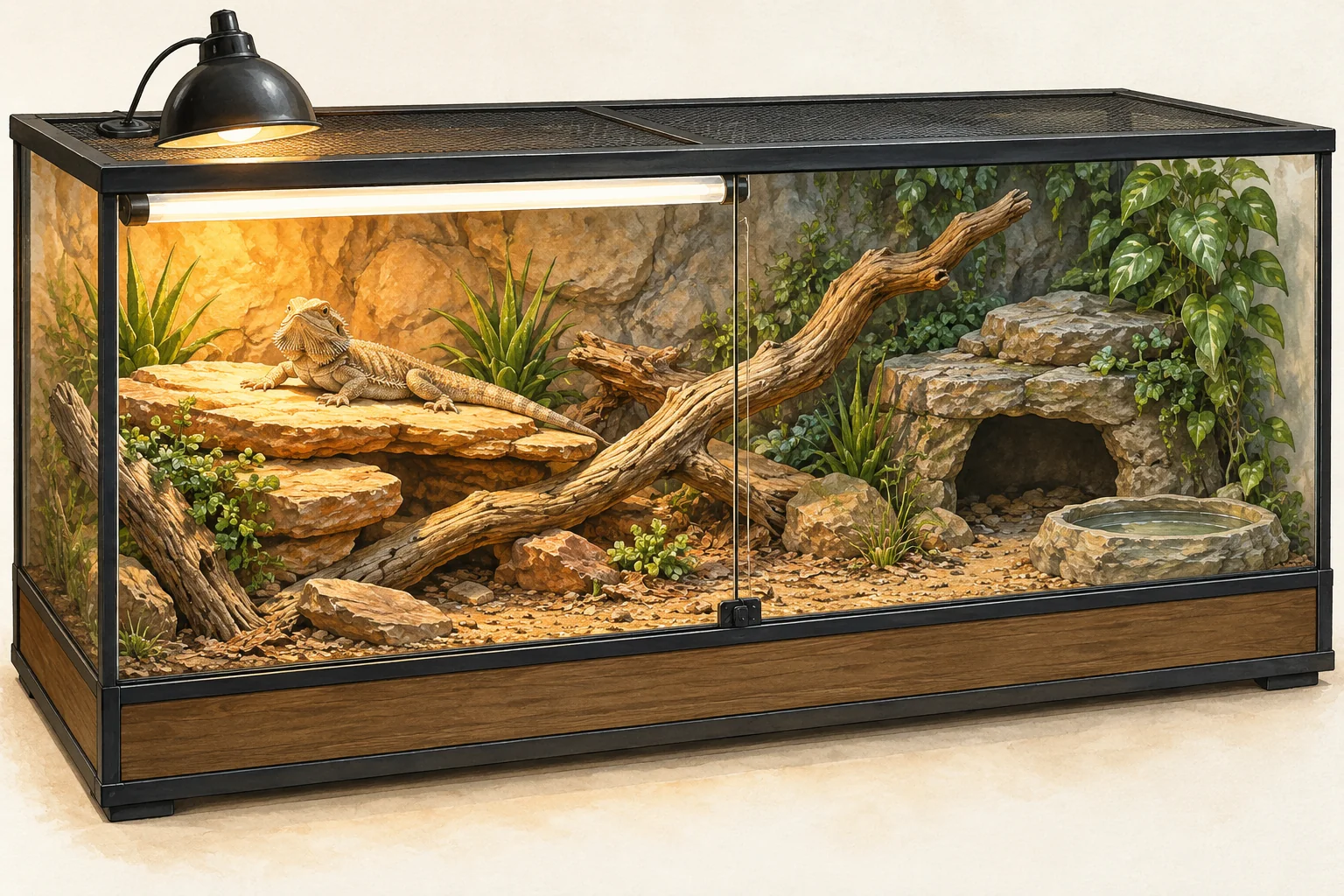
Short answer
For one adult, the RSPCA minimum is 120 × 60 × 60 cm, about 4 × 2 × 2 feet, which is a 120-gallon enclosure. ReptiFiles now recommends 6 × 2 × 2 feet, and the UK's Federation of British Herpetologists about 6 × 3 × 3 feet. VCA asks for a length at least three times the dragon's total length. A juvenile can start in about 20 gallons, but a 40-gallon tank is too small for an adult.
The short version
| Source | Minimum for one adult |
|---|---|
| RSPCA | 120 × 60 × 60 cm (about 4 × 2 × 2 ft)1 |
| VCA | 60 to 100 gallons or more; length at least 3× the dragon’s total length; width at least 16 in2 |
| ReptiFiles | 6 × 2 × 2 ft (24 cubic feet); 4 × 2 × 2 ft for dragons under about 18 in3 |
| Federation of British Herpetologists (via ReptiFiles) | About 6 × 3 × 3 ft3 |
Why the numbers keep going up
ReptiFiles traces the history. A 36 × 18 × 18 inch enclosure was once thought plenty. The standard then rose to 48 × 18 × 21, then to 48 × 24 × 24, as keepers saw that dragons in smaller enclosures could not regulate their temperature or exercise properly.3
The reasons are practical:
- Room for a heat gradient. A dragon needs a hot basking end and a cool end far enough apart to choose between them.23
- Exercise. Adults reach 18 to 22 inches from nose to tail tip.4 VCA’s rule of a length at least three times the total length means about 4.5 to 5.5 feet for a typical adult.2
- Climbing. Bearded dragons climb, so ReptiFiles recommends at least 24 inches of height and, where possible, 3 feet.3
Babies and juveniles
VCA gives a 20-gallon tank as the minimum for a juvenile, depending on its size, moving up to 60–100 gallons or more as it grows.2
What to look for in an enclosure
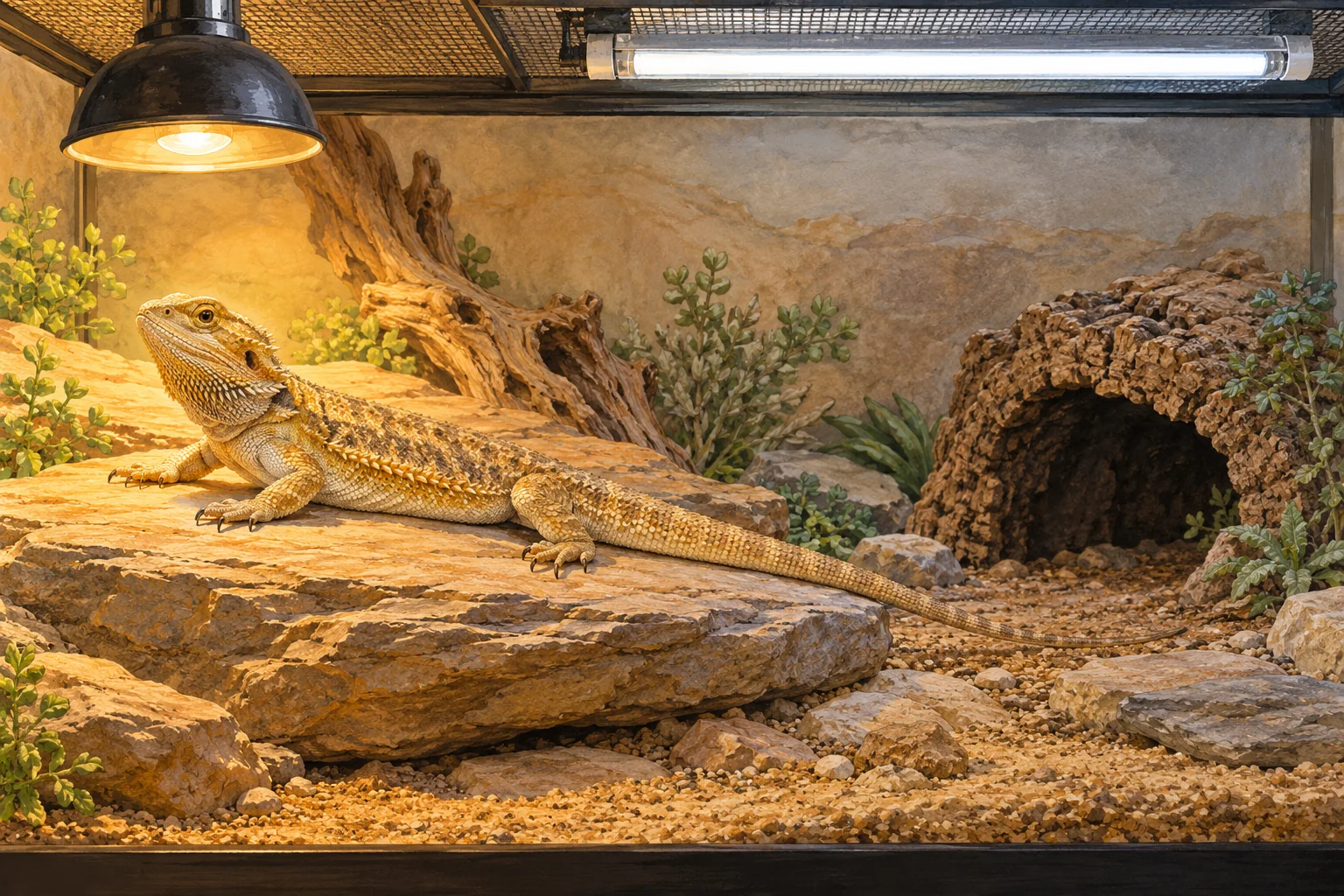
- A secure, ventilated top to keep the dragon in and other pets out.2
- Ventilation to reduce the risk of respiratory infection.1
- Solid sides that hold heat and are easy to clean.1
- A mesh top that does not block too much UVB. ReptiFiles lists mesh obstruction rates of 18% to 33% for the enclosures it recommends.3 More obstruction means the UVB lamp has to sit closer. See our lighting guide.
One dragon per enclosure
A bigger enclosure does not make room for a second dragon. VCA says bearded dragons are usually best housed alone, because they compete for food and basking space and may fight.2 ReptiFiles adds that two males should never be housed together, a male and female will breed, and adults may injure or eat juveniles.3
Next: set up the heat and UVB, then choose a substrate.
Common questions
Is a 40-gallon tank big enough for a bearded dragon?
Only for a juvenile. ReptiFiles describes the old 36 × 18 × 18 inch standard as inadequate for an adult, and the RSPCA minimum of 4 × 2 × 2 feet has more than two and a half times the volume of a 40-gallon breeder tank.
Is a 75-gallon tank enough?
A standard 75-gallon aquarium is about 4 feet long but only 18 inches deep, narrower than the 2-foot depth in the RSPCA and ReptiFiles minimums. A 4 × 2 × 2 ft enclosure (120 gallons) meets the RSPCA minimum.
Can I start a baby in the adult enclosure?
VCA gives a 20-gallon tank as the starting minimum for a juvenile and 60 to 100 gallons or more as it grows.
Do bearded dragons need tall enclosures?
ReptiFiles recommends at least 24 inches of height, and 3 feet of usable height where possible, because bearded dragons climb. VCA notes that young dragons climb more often, and adults climb to bask.
Sources
Numbers in the text link to these sources. We checked each one on the date shown.
- 1Caring for your bearded dragonRSPCA. Checked Oct 29, 2026.
- 2Bearded Dragons: HousingGregory Rich, DVM; Laurie Hess, DVM; Rick Axelson, DVM. VCA Animal Hospitals. Checked Oct 29, 2026.
- 3Bearded Dragon Enclosure Size & CohabitationReptiFiles. Checked Oct 29, 2026.
- 4Bearded Dragons: OwningGregory Rich, DVM; Laurie Hess, DVM; Rick Axelson, DVM. VCA Animal Hospitals. Checked Oct 29, 2026.
Update history
- : First published.
- : Re-checked every claim against its sources; corrected wording, numbers and attributions.
HerpWise Editorial · About the author and review process
HerpWise Editorial summarizes published veterinary, welfare and specialist care guidance. The sources and check date are listed on each guide. Veterinary review is credited separately when completed.
Suggest a correction to this guide