Short answer
Vets and specialist keepers disagree. VCA recommends solid floors such as paper or reptile carpet and advises against sand. The RVC recommends newspaper, artificial turf or certain commercial substrates. ReptiFiles recommends a packed 4–6 inch layer of sand and soil that lets the dragon dig, arguing that impaction comes from poor heat, dehydration and parasites rather than sand itself. Both sides agree to avoid wood chips, and VCA and ReptiFiles also rule out calcium sand and walnut shell. If you are unsure, start on a solid floor and ask your vet.
Why this is the most argued-about question
“What substrate should I use?” is one of the most-asked questions about bearded dragons. The reason is simple: the most trusted sources give opposite answers.
- Veterinary care sheets worry about impaction, a gut blockage that can happen when a dragon swallows loose material. VCA advises against sand, gravel, wood shavings, walnut shell, corncob and cat litter.1 The RVC recommends newspaper, artificial turf or certain commercial products, and says never to use wood chip.2
- ReptiFiles, a specialist care site, recommends a deep, packed natural substrate so the dragon can dig.3 It argues that impaction is a symptom of other problems rather than something sand causes on its own.4
Below is what each side recommends, what they agree on, and how to choose.
Option 1: a solid floor
| Substrate | For | Against |
|---|---|---|
| Newspaper, butcher paper, paper towel | Cheap and easy to replace13 | No digging; better for quarantine than long-term housing3 |
| Reptile carpet | Allowed by VCA if you keep two pieces and swap them when soiled1 | ReptiFiles says the fibers trap bacteria and can catch claws and break toes3 |
| Unpolished stone tile | Holds heat and looks natural3 | Little digging value3 |
This is the cautious choice, and the one we suggest for a new dragon, a young dragon, or any dragon that is unwell.
Option 2: a packed, diggable mix
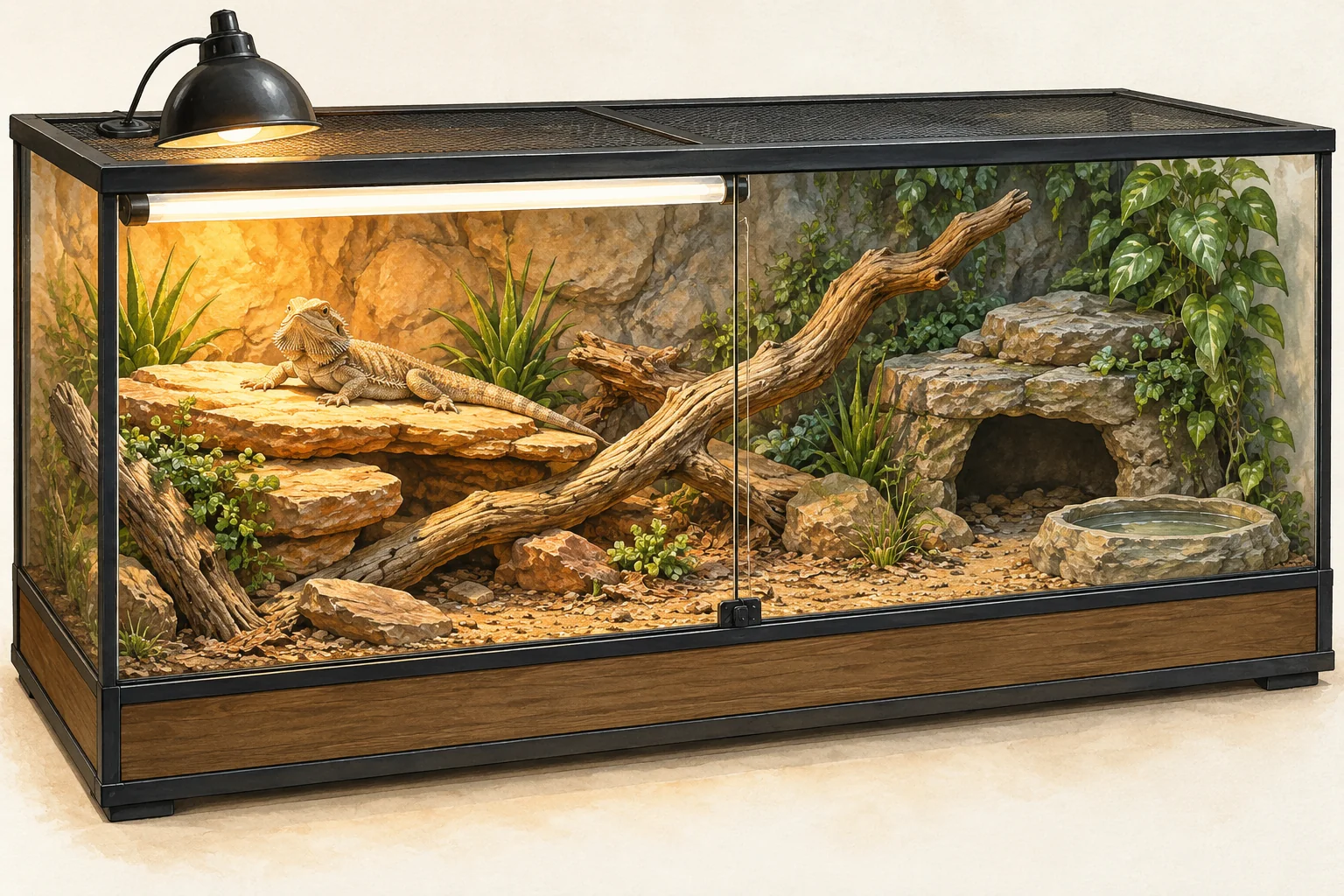
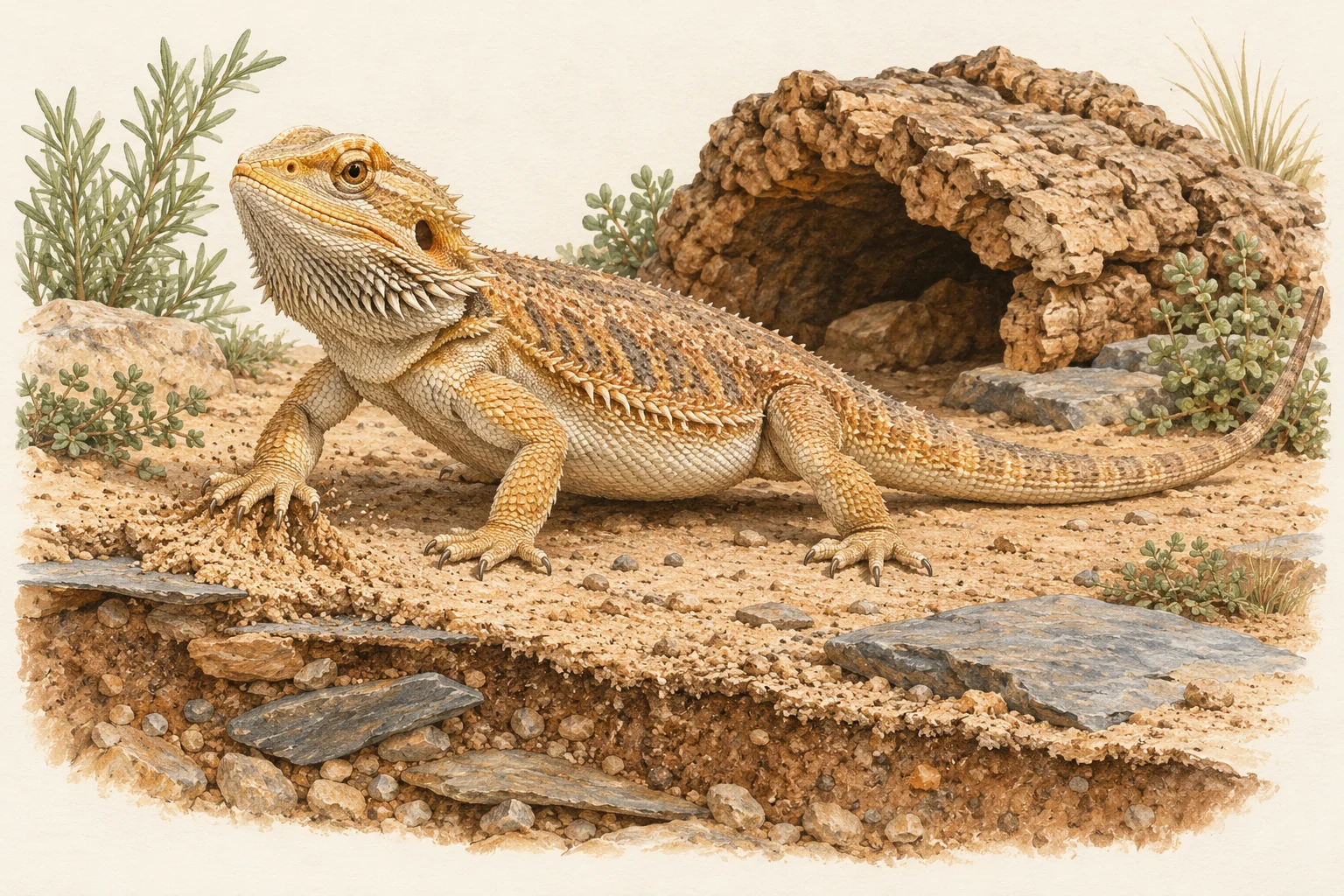
A deep, loose substrate lets a bearded dragon dig.3 ReptiFiles recommends a natural loose substrate that packs well, laid 4–6 inches deep.3
- DIY mix: 50% very fine sand, 30% organic topsoil and 20% Zoo Med Excavator Clay.3
- How much: about 80–120 quarts for a 4 × 2 ft enclosure, or 120–180 quarts for 6 × 2 ft.3
- Upkeep: spot-clean daily, removing the sand around any waste, and replace sand every 3–6 months.3
- Avoid dusty play sand and dyed sand in green, pink or blue.3
ReptiFiles cites a 2017 study of 529 captive bearded dragons by Schmidt-Ukaj and colleagues. Most were kept on loose substrate, yet very few had impaction, and those that did were mostly already sick with parasites or metabolic bone disease.3
What everyone agrees to avoid
| Substrate | Why |
|---|---|
| Calcium sand (Vita-Sand, Reptilite) | VCA: can still cause a blockage.1 ReptiFiles: calcium carbonate can clump in the gut and upset digestion.3 |
| Ground walnut or nut shell | Blockage risk if swallowed.13 |
| Wood chips, bark, shavings | Blockage risk if swallowed.123 Cedar oils are harmful to reptiles.1 |
| Corncob, cat litter, gravel | Blockage risk if swallowed.1 |
Lowering the impaction risk on any substrate
ReptiFiles lists the conditions that make impaction more likely, whatever the floor:4
- Dehydration, which dries out the gut.
- A basking spot that is too cool, which slows digestion.
- Too little UVB or vitamin D3, which it links to a slower gut.
- A poor diet, such as too many insects and too few greens, or an overweight dragon.
VCA adds that dragons may swallow substrate while catching insects or eating greens.1 Feeding greens in a dish, and insects in a dish or a bare area, cuts the amount they take in.
Get the heat and UVB right and keep the diet mostly greens for adults. Those matter whichever floor you choose.
Common questions
Is play sand safe for bearded dragons?
ReptiFiles advises against play sand because it is the dustiest, and recommends high-quality sand mixed with soil. VCA advises against sand of any kind. Either way, avoid dyed sand and calcium sand.
Is calcium sand safe?
No. Both VCA and ReptiFiles advise against it. VCA says so-called digestible calcium sand can still cause a blockage, and ReptiFiles says calcium carbonate can clump in the gut and interfere with digestion.
Is reptile carpet good for bearded dragons?
Sources split. VCA allows it if you keep two pieces and swap a soiled one for a clean, dry one. ReptiFiles advises against it because the fibers trap bacteria and can catch claws.
How deep should bearded dragon substrate be?
If you use a loose mix, ReptiFiles recommends 4–6 inches, packed firmly so the dragon can dig. A 4 × 2 ft enclosure needs roughly 80–120 quarts.
Can I use topsoil for a bearded dragon?
As part of a mix. ReptiFiles' DIY mix is 50% very fine sand, 30% organic topsoil and 20% Excavator Clay, packed 4–6 inches deep.
Sources
Numbers in the text link to these sources. We checked each one on the date shown.
- 1Bearded Dragons: HousingGregory Rich, DVM; Laurie Hess, DVM; Rick Axelson, DVM. VCA Animal Hospitals. Checked Oct 29, 2026.
- 2Bearded dragon careRVC Exotics Service, Royal Veterinary College. Checked Oct 29, 2026.
- 3Bearded Dragon Substrate OptionsReptiFiles. Checked Oct 29, 2026.
- 4Does Loose Substrate Cause Impaction?ReptiFiles. Checked Oct 29, 2026.
Update history
- : First published.
- : Re-checked every claim against its sources; corrected wording, numbers and attributions.
HerpWise Editorial · About the author and review process
HerpWise Editorial summarizes published veterinary, welfare and specialist care guidance. The sources and check date are listed on each guide. Veterinary review is credited separately when completed.
Suggest a correction to this guide