Short answer
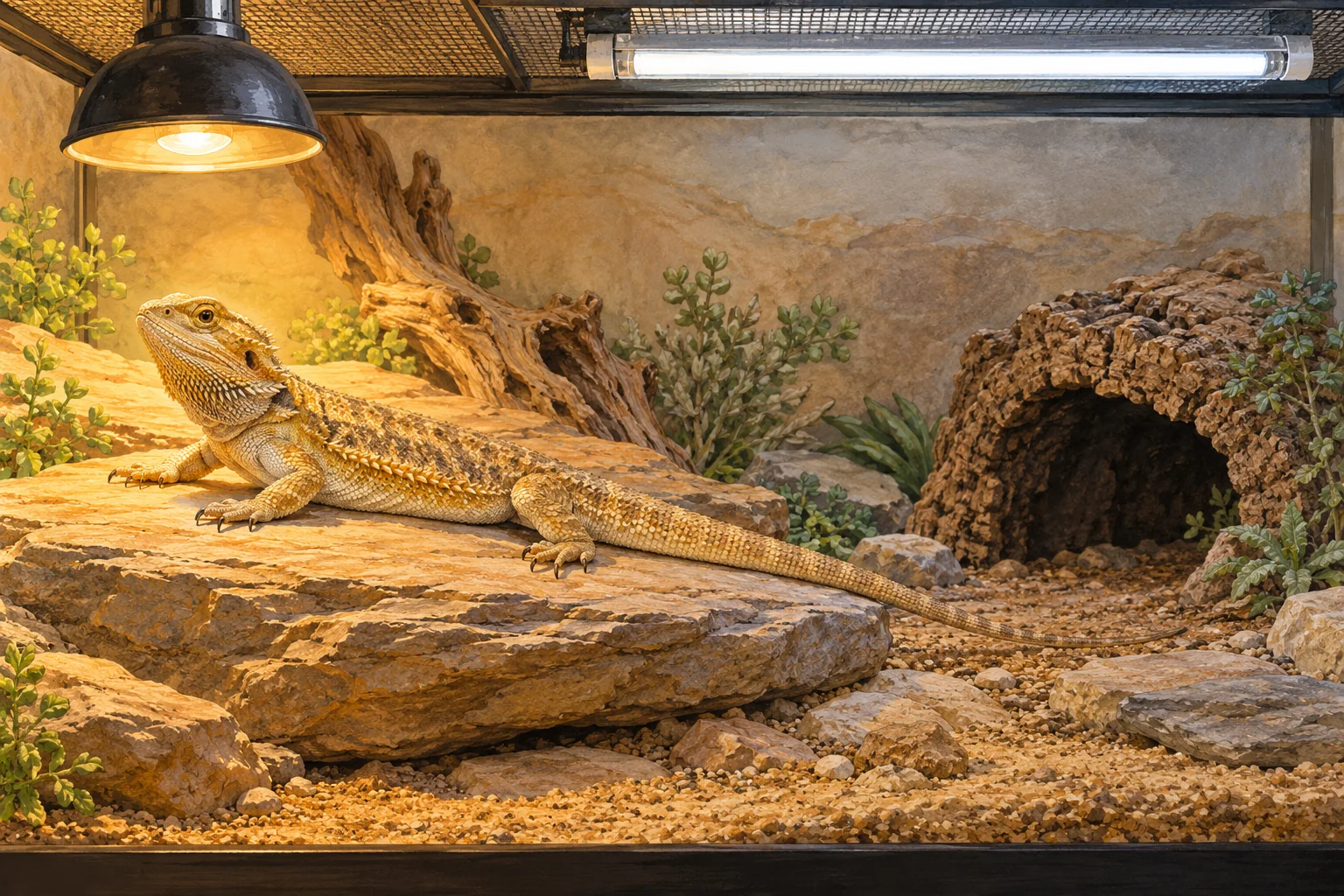
A bearded dragon needs a strong linear UVB tube and separate heat lamps over one basking spot. Aim for a UV index of about 4.0–4.5 and a surface of 108–113°F on the basking spot, and 77–85°F at the cool end. Nothing made of glass or plastic can sit between lamp and dragon, and mesh cuts UVB, so measure. Run lights about 12 hours a day, turn them all off at night, and replace the UVB tube every 6–12 months.
Why lighting matters more for bearded dragons
Bearded dragons need UVB to make vitamin D3 in their skin, and vitamin D3 lets them absorb calcium from food.2 Without enough UVB they can develop metabolic bone disease, which weakens the bones and can be life-threatening.2
Heat matters just as much. Reptiles take their body heat from their surroundings, and a dragon that is too cold digests poorly and fights infection less well.2
So a bearded dragon needs two kinds of lamp: a UVB lamp, and a heat source over one basking spot. Some bulbs give both, but a heat bulb does not necessarily give UVB.2
The setup at a glance
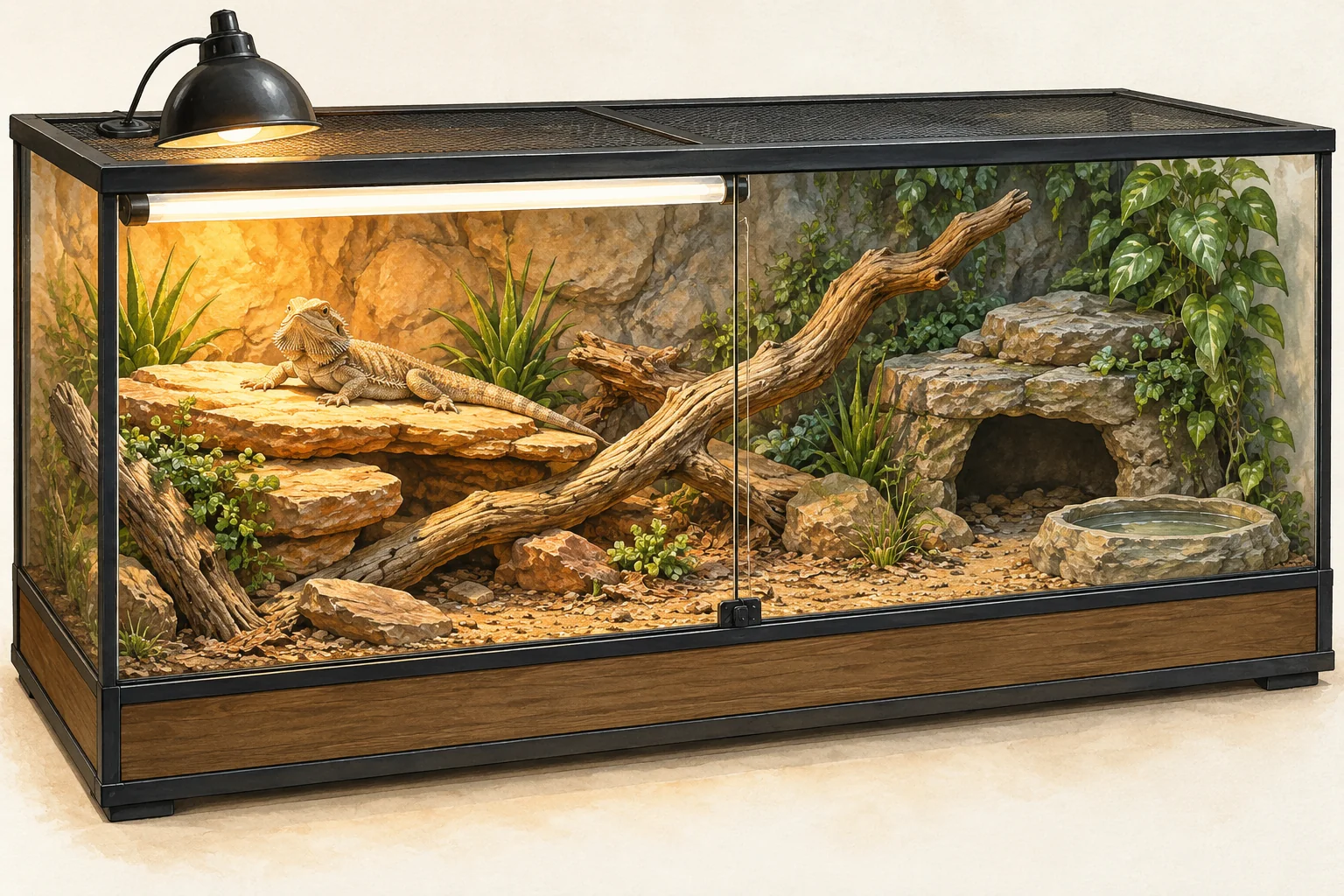
- Basking surface
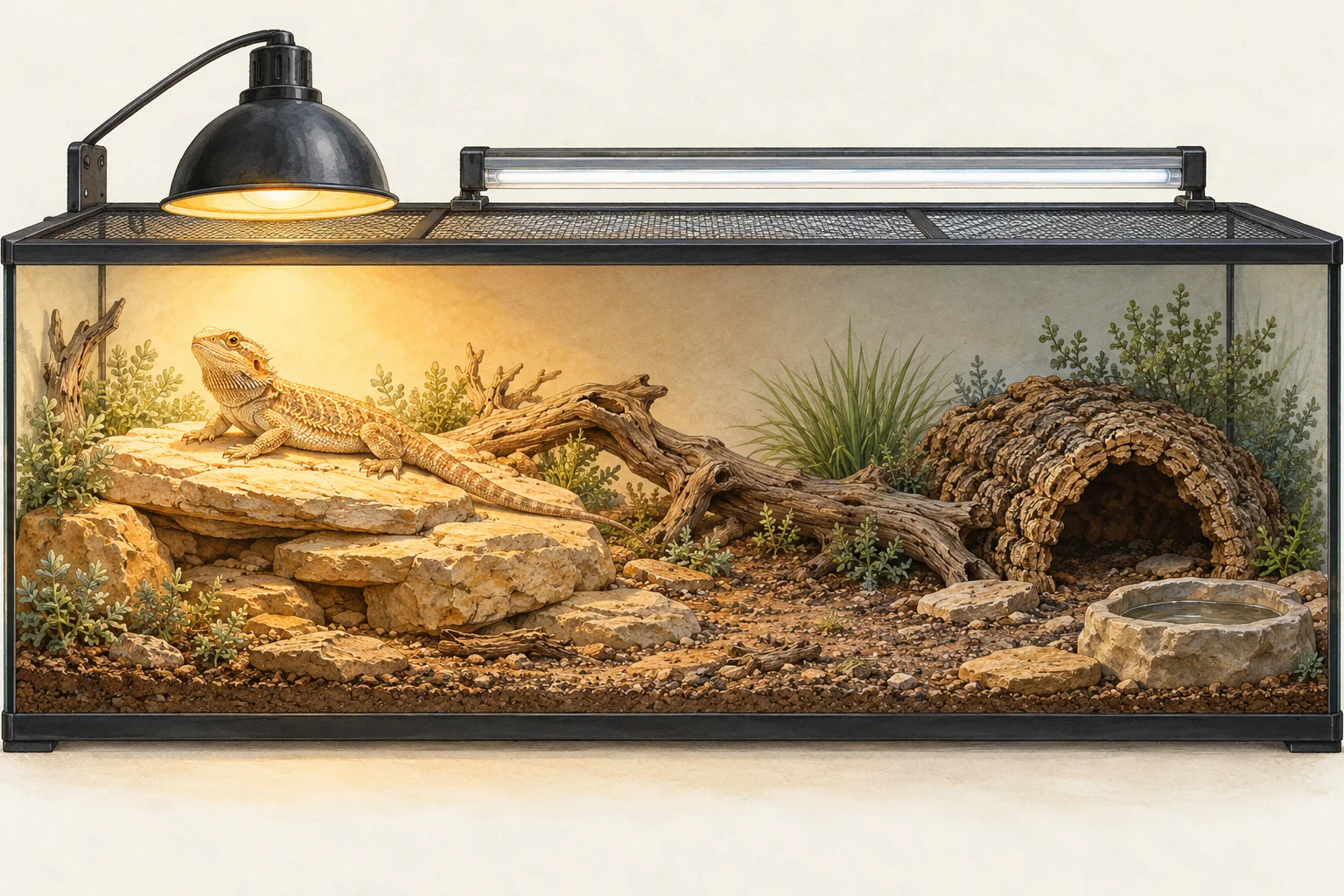
- 108–113°F · UVI 4.0–4.5, per ReptiFiles.
- Cool surface
- 77–85°F, with a fully shaded hide.
- Lamp spacing
- For the Arcadia 12% T5 HO example: 11 in through mesh, 16–17 in without mesh. Check the lamp-specific guidance.
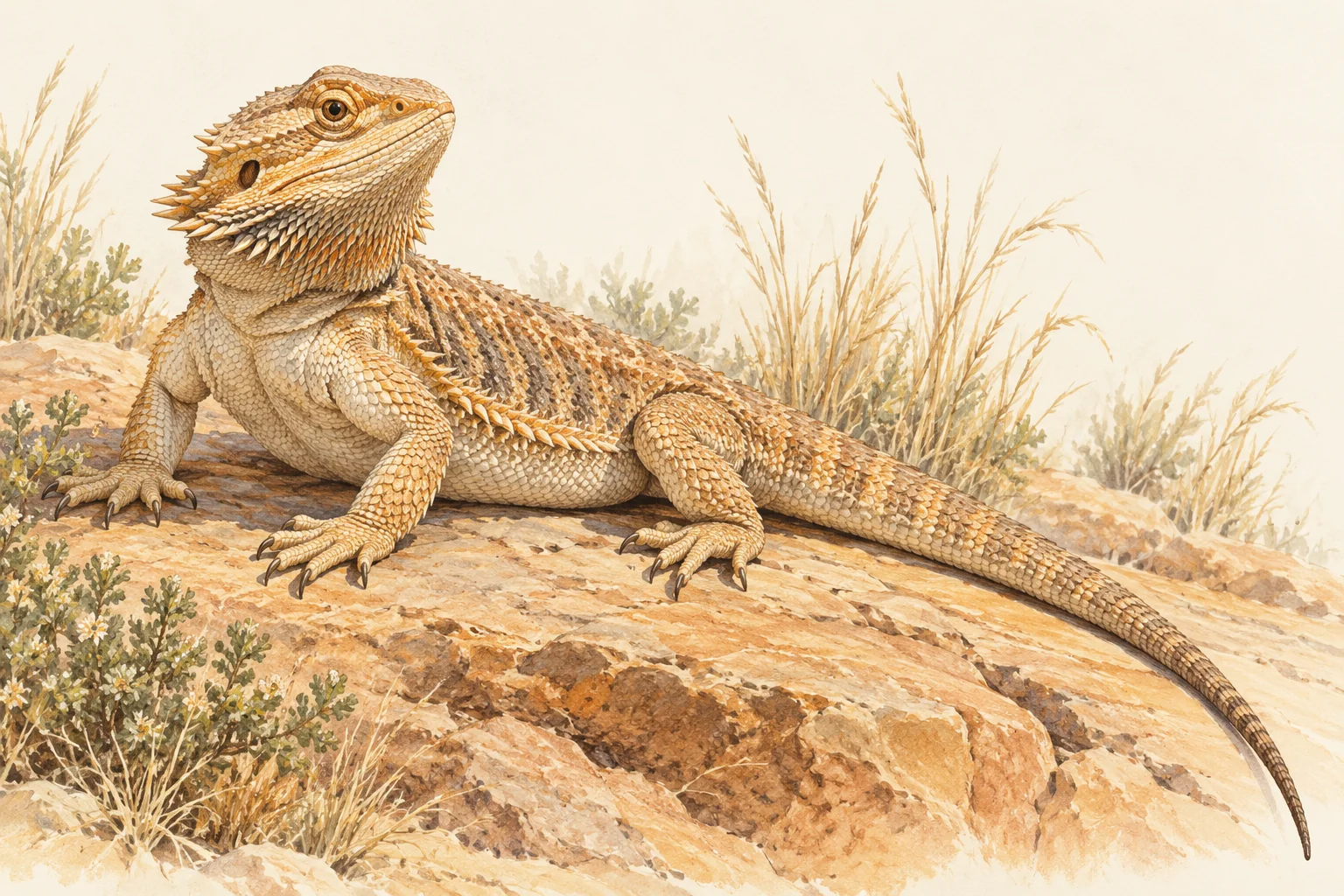
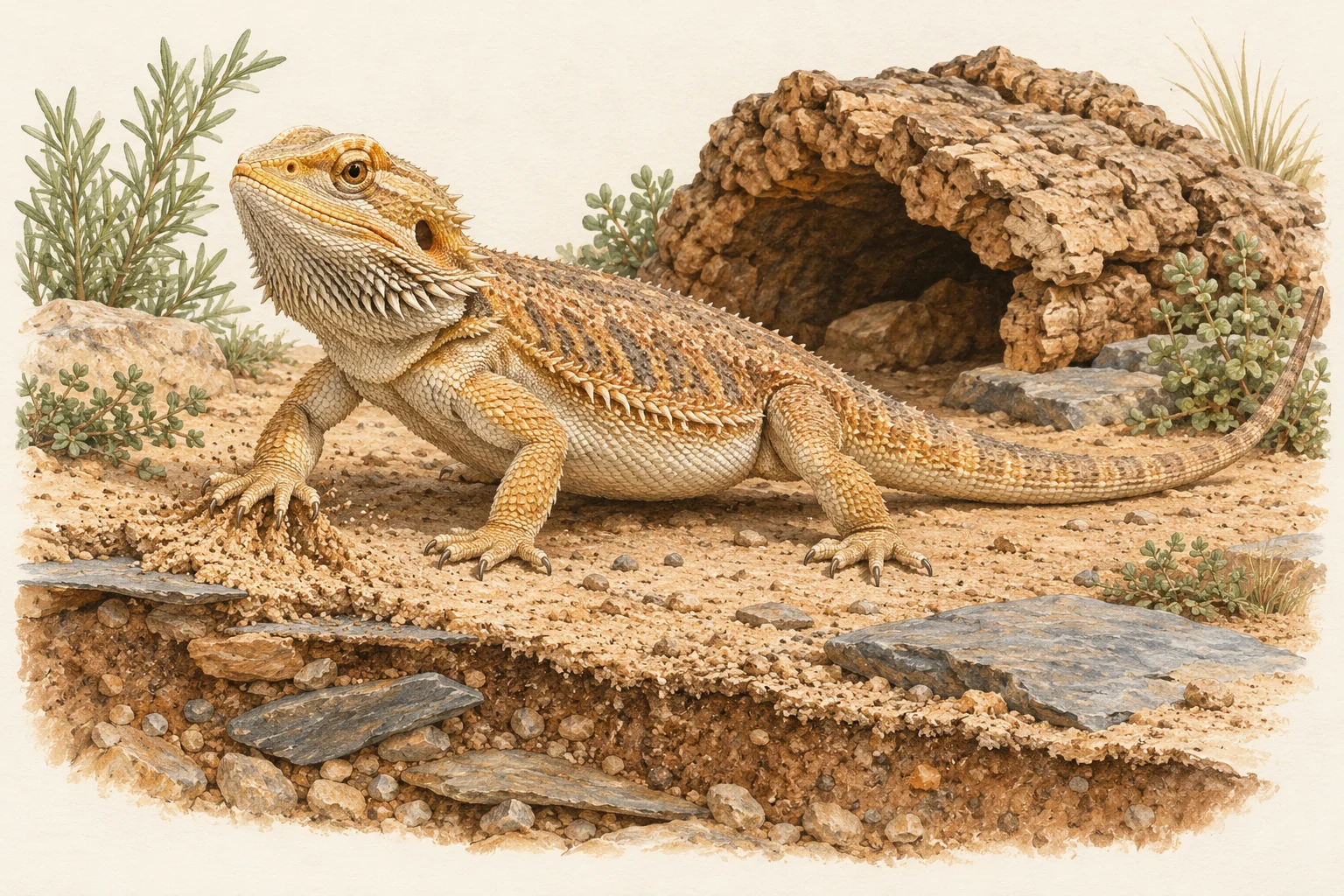
AI-generated educational illustration. Use the source-linked text for measurements and care decisions.
| What | Target | Source |
|---|---|---|
| UV index at the basking spot | 4.0–4.5, falling to 0 at the cool end | ReptiFiles1 |
| Basking surface | 108–113°F (42–45°C), never above 122°F (50°C) | ReptiFiles1 |
| Warm end, air | 90–100°F (32–38°C) | VCA2 |
| Cool end | 75–80°F air (VCA); 77–85°F surface (ReptiFiles) | 21 |
| Night | Lights off; extra heat may not be needed if the cool end stays at 65–80°F | VCA2 |
| Day length | About 12 hours of UVB | RVC3 |
The basking surface figure is hotter than the air figure because it is measured on the rock or tile itself, not in the air around it. Use an infrared thermometer for the surface and a probe thermometer for the air. VCA notes that the infrared gun does not replace the air thermometer.2
Choosing a UVB lamp
ReptiFiles recommends a high-output (T5 HO) linear UVB tube, and lists these with their mounting distance to the basking surface:1
| Lamp | Through mesh | No mesh |
|---|---|---|
| Arcadia T5 HO Desert 12% | 11 in (27 cm) | 16–17 in (40.5–42 cm) |
| Zoo Med T5 HO ReptiSun 10.0 in an Arcadia fixture | 11 in (27 cm) | 16–17 in (40.5–42 cm) |
| Arcadia T5 HO Dragon 14% | 11–12 in (28–30 cm) | 17–18 in (43–45 cm) |
- Length. A 22-inch tube is a good size. Run it along the warm side, parallel to the heat lamps, so it covers the dragon’s whole body while basking.1
- Other brands. ReptiFiles has no distance chart for Reptile Systems or Exo Terra tubes, and advises measuring with a Solarmeter 6.5 instead.1
- If you cannot measure, add 1–3 inches to the distances above to allow for the dragon’s height.1
- Pale morphs. Hypomelanistic, translucent and silkback dragons should stay at a UV index of 3.0 or below.1
The RVC care sheet instead recommends mercury vapour lamps, which give both UVB and heat.3 They cannot be run on a thermostat and can overheat a small enclosure, so check temperatures closely if you use one.3
The mesh problem
Glass and plastic block UVB.1 Never put a UVB lamp above a glass lid or behind a plastic cover. VCA adds that mesh screening also cuts UVB exposure.2
That is why the “through mesh” distances above are shorter.
If your lamp sits on a mesh lid, either move it closer or mount it inside the enclosure. Then check the UV index at the basking spot with a meter.
Heat lamps
- Use at least two halogen or incandescent flood bulbs over the basking spot, so the heat covers the dragon’s whole body.1
- Mount heat sources outside and above the enclosure, where the dragon cannot touch them.2
- Use lamp holders rated for the wattage, with ceramic sockets.1
- Check temperatures after setting up or changing anything, about three hours after the lamps come on.12
- Never use hot rocks. They can get hot enough to burn your dragon.2
Night time
Turn all lights off at night and let the temperature drop.2 VCA says extra heat may not be needed if the cool end stays between 65°F and 80°F (18–27°C).2 ReptiFiles gives a wider range of 55–75°F (12–24°C).1
VCA lists ceramic heat emitters and reptile heating pads among suitable heat sources, and says heat sources should run on a thermostat.2 Neither gives off light, so either can add warmth at night if your room gets colder.
Replacing the UVB lamp
UVB output fades with age while the visible light still looks fine.2 Write the install date on the fixture.
| Source | Replace every |
|---|---|
| VCA | 6 months, or as the maker directs2 |
| ReptiFiles | About 12 months for most T5 HO tubes; 6 months for Exo Terra1 |
| RVC | At least as often as the maker advises3 |
The safest rule is to follow the maker’s instructions. If you own a UV meter, measure the basking spot instead of guessing.
Where the sources disagree
- Lamp type. ReptiFiles prefers a T5 HO tube plus halogen heat lamps.1 The RVC recommends mercury vapour lamps.3 Both can work if the UV index and temperatures are right.
- Replacement. VCA gives six months; ReptiFiles gives about a year for most T5 HO tubes.21
- Night low. VCA’s range is warmer than ReptiFiles’.21 If you are unsure, stay within VCA’s 65–80°F.
Common questions
Can I put the UVB light on top of the screen lid?
You can, but mesh blocks part of the UVB, so the lamp has to sit closer to the basking spot. ReptiFiles gives 11 inches through mesh against 16–17 inches with no mesh for an Arcadia 12% T5 HO. Glass and plastic block UVB completely.
Should I leave the heat lamp on at night?
No. Turn all lights off at night. VCA says extra night heat may not be needed if the cool end stays between 65°F and 80°F. If your room gets colder, a ceramic heat emitter or heat pad on a thermostat adds warmth without light.
How long should the lights be on each day?
The RVC care sheet runs UVB for 12 hours a day. Put the lamps on a timer so the day length stays the same.
Is a "full spectrum" bulb the same as UVB?
No. VCA warns that a bulb labelled full spectrum does not necessarily give enough UVB. Buy a lamp sold as a reptile UVB lamp and check its output.
How often should I replace the UVB bulb?
VCA says every six months or as the maker directs, because UVB output fades before the visible light does. ReptiFiles gives about 12 months for most T5 HO tubes and 6 months for Exo Terra tubes.
Can a bearded dragon get too much UVB?
Yes. ReptiFiles aims for a UV index of 4.0–4.5 at the basking spot and 3.0 or below for hypomelanistic, translucent and silkback dragons. VCA adds that the enclosure needs hides or shaded areas where the dragon can move away from the light.
Do I need a UV meter?
It is the only way to know what reaches the basking spot, especially through mesh. ReptiFiles recommends a Solarmeter 6.5 and has no distance chart for some brands, so measuring is the reliable option.
Sources
Numbers in the text link to these sources. We checked each one on the date shown.
- 1Bearded Dragon Lighting, Heating & Humidity RequirementsMariah Healey. ReptiFiles. Checked Oct 29, 2026.
- 2Bearded Dragons: HousingGregory Rich, DVM; Laurie Hess, DVM; Rick Axelson, DVM. VCA Animal Hospitals. Checked Oct 29, 2026.
- 3Bearded dragon careRVC Exotics Service, Royal Veterinary College. Checked Oct 29, 2026.
Update history
- : First published.
- : Re-checked every claim against its sources; corrected wording, numbers and attributions.
HerpWise Editorial · About the author and review process
HerpWise Editorial summarizes published veterinary, welfare and specialist care guidance. The sources and check date are listed on each guide. Veterinary review is credited separately when completed.
Suggest a correction to this guide